


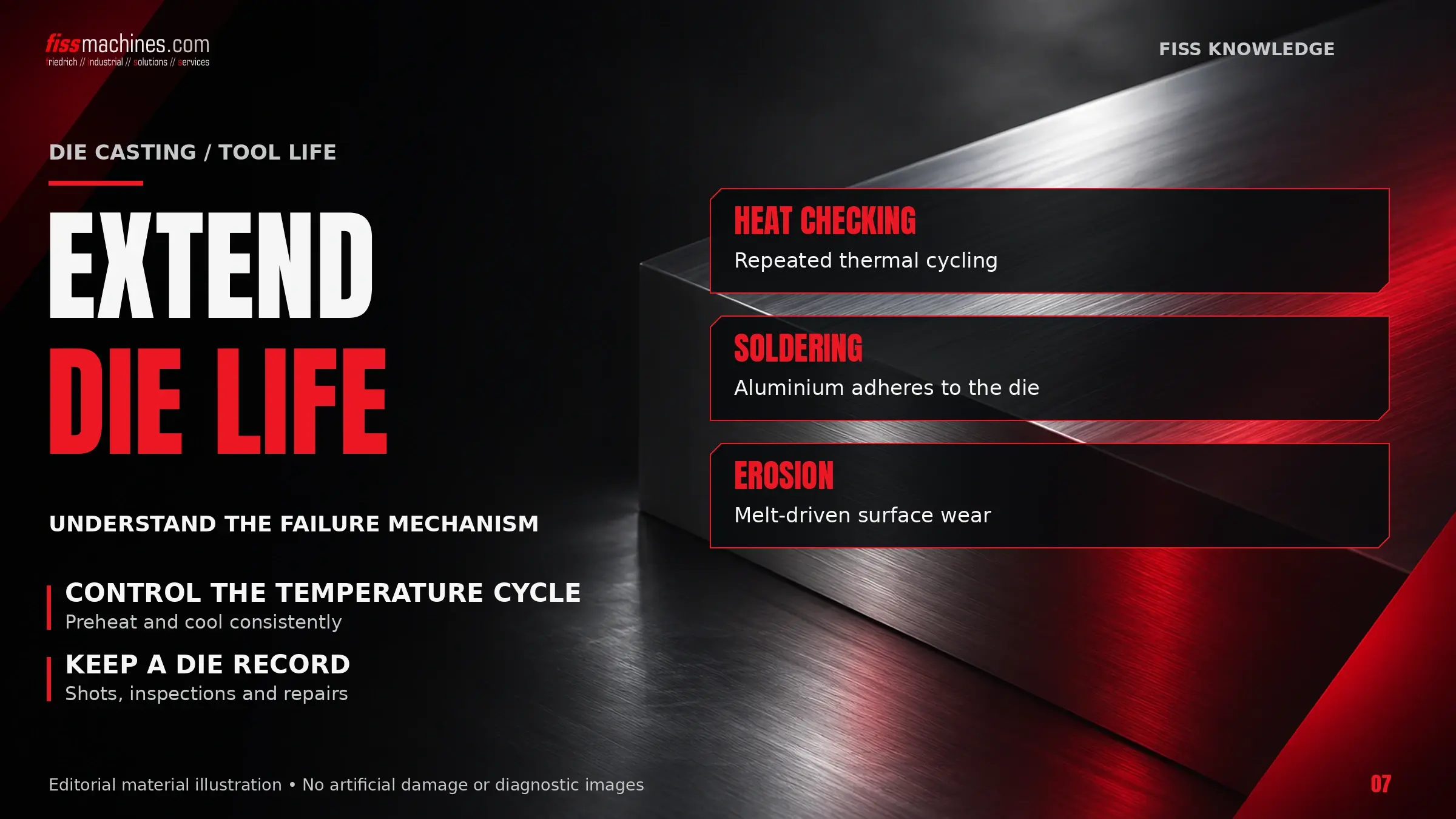
Die Life in Die Casting: Heat Checking, Soldering and Erosion
A die casting die is one of the most expensive items in the cell, and every unplanned die change costs production time. How long a die lasts depends less on luck than on a few well-understood damage mechanisms – and on how consistently the process keeps them in check.
What Limits Die Casting Die Life?
In aluminium high-pressure die casting, die casting die life is limited mainly by four mechanisms: heat checking (thermal fatigue cracks), gross cracking, soldering of the alloy to the die and erosion by the flowing melt. Heat checking is by far the most frequent.
The levers are the temperature cycle of the die surface, melt velocity and chemistry, the hot-work steel and its heat treatment, surface treatment, and die care such as preheating, stress tempering and documented inspection.
Four Mechanisms That End a Die’s Life
How a die is built is explained in Understanding Die Casting Dies – here the focus is on how it wears out.
Heat Checking
A network of fine surface cracks from repeated heating and cooling. It marks the casting and can initiate larger cracks.
Gross Cracking
Deep cracks from thermal shock or mechanical overload. Rare, but it stops production.
Soldering
Aluminium reacts with the iron of the die and forms intermetallic layers; the casting sticks, typically on hot core pins.
Erosion
Hot mechanical wear from the fast-moving melt, mostly near gates.
Uddeholm also lists corrosion by the molten metal and indentation of parting lines. In an Uddeholm white paper, industry experts at EUROGUSS 2018 estimated heat checking at 60 to 80 percent of all die failures.
How Many Shots Does a Die Casting Die Last?
Die life depends strongly on the casting alloy, because the casting temperature determines the thermal load. The ranges below are manufacturer orientation values from Uddeholm, not guarantees.
| Casting Alloy | Main Limiting Factors | Normal Life, Die (Shots) | Normal Life, Cores (Shots) |
|---|---|---|---|
| Zinc (approx. 430 °C) | Erosion | 0.5–2 million | 0.5–2 million |
| Magnesium (approx. 650 °C) | Heat checking, cracking, erosion, indentation | 100,000–400,000 | 50,000–200,000 |
| Aluminium (approx. 700 °C) | Heat checking, cracking, erosion, indentation | 60,000–200,000 | 40,000–150,000 |
| Copper / brass (approx. 970 °C) | Heat checking, indentation, erosion, cracking | 5,000–50,000 | 1,000–5,000 |
Where the Damage Comes From
Thermal fatigue cracks need cyclic thermal stress, tensile stress and plastic strain at once; every increase in the temperature swing accelerates them. Soldering and erosion depend more on melt velocity, temperature and chemistry.
| Cause | Main Effect | Background |
|---|---|---|
| Cold die at start-up | Heat checking, cracking | Severe shock; heat checking can start at the first shot. |
| High surface temperature | Heat checking, soldering | Per Uddeholm, the risk rises significantly above approx. 600 °C. |
| Abrupt cooling | Heat checking | Intensive spraying or very cold coolant raises stresses. |
| Unfavourable cooling channels | Hot spots, cracking | Aim for uniform cavity temperature and sufficient distance. |
| High gate velocity | Erosion, soldering | Above approx. 55 m/s erosion rises substantially; the release film washes away. |
| Alloy chemistry | Soldering, erosion | Low iron content increases die attack; hypereutectic silicon adds erosion. |
| Stress raisers | Cracking | Sharp fillets, corners and untreated EDM layers. |
The thermal balance is described in Temperature Control in Die Casting, spray pattern and quantity in Die Spraying in Die Casting.
Hot-Work Tool Steel, Heat Treatment and Hardness
The standard materials for inserts are the hot-work tool steels 1.2343 (H11) and 1.2344 (H13). Steel makers offer remelted (ESR) qualities and premium grades such as Uddeholm Dievar or the BÖHLER grades W350 ISOBLOC and W400 VMR. Acceptance criteria are often based on NADCA #207, Special Quality Die Steel & Heat Treatment Acceptance Criteria for Die Casting Dies.
- Hardness: Higher hardness resists heat checking but raises the risk of gross cracking. Uddeholm advises against more than 50 HRC for aluminium.
- Quenching: A high quenching rate gives the best die life; slow cooling reduces toughness.
- Tempering: At least two, a third is generally recommended.
- Surface zone: Decarburisation and heavy carburisation can cause premature heat checking.
Steel makers report markedly better heat checking resistance for their premium grades than for standard H13. These are manufacturer statements; a premium steel only pays off if design and process are right too.
Preheating, Surface Treatment and Stress Tempering
Preheat Gradually
Uddeholm recommends 180–300 °C for aluminium and magnesium dies. Heat evenly under thermostatic control and bring in coolant gradually.
Run In with an Oxide Film
On a glossy surface the release agent adheres poorly. An oxide film – e.g. 500 °C for one hour – reduces metal-to-die contact.
Cool Without Shock
Uddeholm suggests cooling water at approx. 50 °C, advises against water below 20 °C and recommends reduced flow during breaks.
Stress Temper at Intervals
Uddeholm recommends it after running-in, after 1,000–2,000 and 5,000–10,000 shots, then every 10,000–20,000 shots while heat checking is minor – about 25 °C below the highest tempering temperature, normally two hours.
Treat Exposed Areas
Nitriding improves resistance to erosion and soldering on core pins, gates and ejector pins. Hard coatings are also used on core pins.
Monitoring: Shot Counter, Inspection and Die Records
Die life can only be improved if it is measured – with a record per die and per insert.
- Shot count per die and insert, not just per machine
- Inspection at fixed shot intervals, with photos of the same areas
- Stress tempering, welding, polishing and coating with date and shot count
- Process data at the time of damage: temperatures, cycle time, spray settings
- Reason for removal and the failure mechanism observed
Changing fill times can point to damage at gates and cores; see Understanding Shot Curves.
What Die Life Means for Machine and Periphery
The cell decides whether these countermeasures work reliably every shift.
Preheating and Stable Supply
Units must reach the preheating temperature and keep supply stable. Oil units cover higher temperatures; enough circuits allow hot spots to be treated separately.
Defined Quantities
A reproducible, zone-specific spray pattern avoids local shock cooling.
Controlled Velocities
Reproducible shot control keeps gate velocities in the intended range.
FISS lists used temperature control units and die casting machines. Check temperature range, circuits and spray technology against the die concept.
Die Life Is a Process Result
Heat checking, gross cracking, soldering and erosion have known causes: temperature swings, melt velocity, chemistry and stress raisers. Correctly heat-treated hot-work steel is the basis; preheating, controlled cooling and spraying, stress tempering and a die record decide whether the die reaches its potential.
Questions About Die Life in Die Casting
Is H11 or H13 Better for Die Casting Dies?
H13 (1.2344) offers somewhat higher temper resistance, H11 (1.2343) somewhat higher toughness. According to Uddeholm, their heat checking resistance differs little; steel quality, heat treatment and process matter more.
Why Does Aluminium Stick to the Die?
Without an intact release or oxide film, aluminium and iron react and form intermetallic layers. High die temperature, high melt velocity and low-iron alloys increase the tendency.
Does Stress Tempering Help With an Already Heat-Checked Die?
Hardly. According to Uddeholm, the cracks have already reduced the residual stresses. Stress tempering works preventively.
Can Heat Checks Be Repaired?
Shot peening closes some fine cracks, according to Uddeholm. Deeper damage is repaired by welding or the insert is replaced.
Temperature Control and Die Casting Technology from FISS.
Stable die temperatures start with suitable periphery. FISS supplies used temperature control units and die casting machines.
Sources
Uddeholms AB: Uddeholm Tool Steels for Die Casting, brochure, edition 8, 09.2016.
Uddeholms AB: R. Oliver, K. Axelsson, S. Sivertsen, HPDC – New challenges require new ideas, white paper, uddeholm.com, accessed 5 November 2026.
Uddeholms AB: S. Sivertsen, The art of long production series – choose the right die material for High Pressure Die Casting, white paper, uddeholm.com, accessed 5 November 2026.
voestalpine BÖHLER Edelstahl: BDCC – BÖHLER Die Casting Concept: voestalpine BÖHLER Werkzeugstähle für die Druckgussindustrie, brochure, voestalpine.com, accessed 5 November 2026.
M. Kohlhepp, P. J. Uggowitzer, M. Hummel, H. W. Höppel: Formation of Die Soldering and the Influence of Alloying Elements on the Intermetallic Interface, Materials 14 (2021) 1580.
NADCA – North American Die Casting Association: Die Casting Industry Standards, diecasting.org, accessed 5 November 2026.
